Berry, John (1798-1870)
Birthplace:
Hillsborough, North Carolina, USA
Residences:
- Hillsborough, North Carolina
Trades:
- Contractor
- Builder
- Brickmason
Building Types:
Styles & Forms:
Federal; Gothic Revival; Greek Revival

John Berry (August 18, 1798-January 11, 1870) was a Hillsborough brickmason who became one of the most respected builders in the antebellum Piedmont. Berry was one of the first native North Carolina artisans to establish a large, long-lasting, and supra-local practice. Although his work concentrated in his native Orange County, he began early in his career to take major contracts within a several-county region, as far east as Wake Forest and west to Salisbury. He constructed some of the preeminent buildings of the region, both from his own designs and those of architects William Nichols, Alexander Jackson Davis, and others.
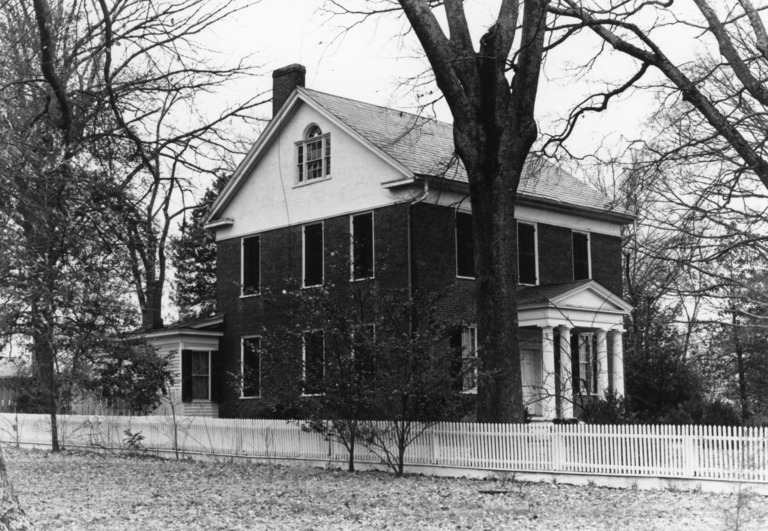
Little is known of Berry’s early life or training. He is said to have been born near Hillsborough, the son of John Berry, Sr., and Rhoda or Rhody Berry. Rhoda Berry and young John were living on Lot 54 of West Queen Street in Hillsborough when she purchased the lot on June 15, 1805. According to tradition, when John was about 16 years old, he helped local brickmason and neighbor Samuel Hancock build the small brick dwelling, the Berry House, for himself and his mother. Berry had a long association with the older man, who is thought to have been a relative by marriage, and he probably learned his trade as an apprentice with Hancock. Although Hancock could not write (he signed documents with an “X”), Berry gained an education through his own efforts or in a local school. In 1827, John Berry married Elizabeth Ann Vincent of the Crossroads community, and the couple soon established a large family.
Working with Samuel Hancock, the young Berry was involved in several substantial local projects. The two men probably built the Hillsborough Presbyterian Church (1815-1816)—one of the first churches built in town after the American Revolution—a restrained and simple building of brick laid in Flemish bond, measuring 50 by 30 feet and featuring a hip roof. Presbyterian patronage continued when the Reverend John Knox Witherspoon employed Hancock and Berry to renovate his house known as Twin Chimneys. Witherspoon’s half-brother Frederick Nash hired Hancock and Berry to erect a 2-story frame house attached to his old dwelling on Margaret Lane; “J. Berry for Hancock & Berry” appears on Nash’s receipts. In 1819 Hancock borrowed money from Dr. James Webb to buy lots on the Eno River for a brickyard, which Hancock and Berry used for local projects for many years.
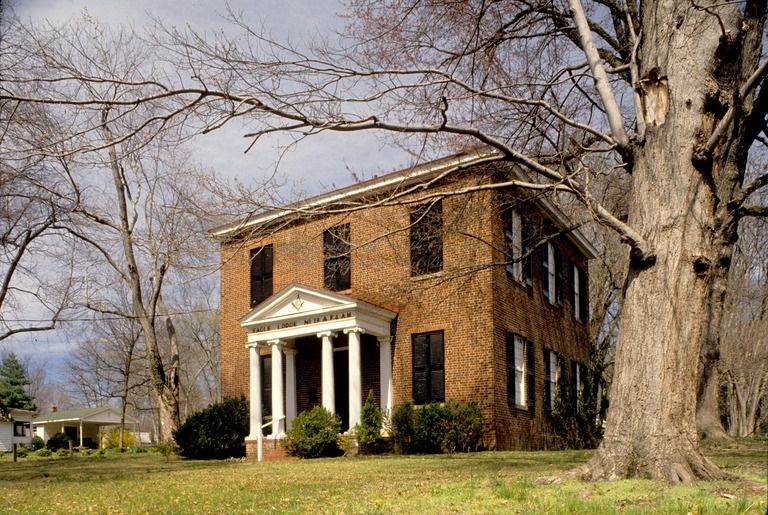
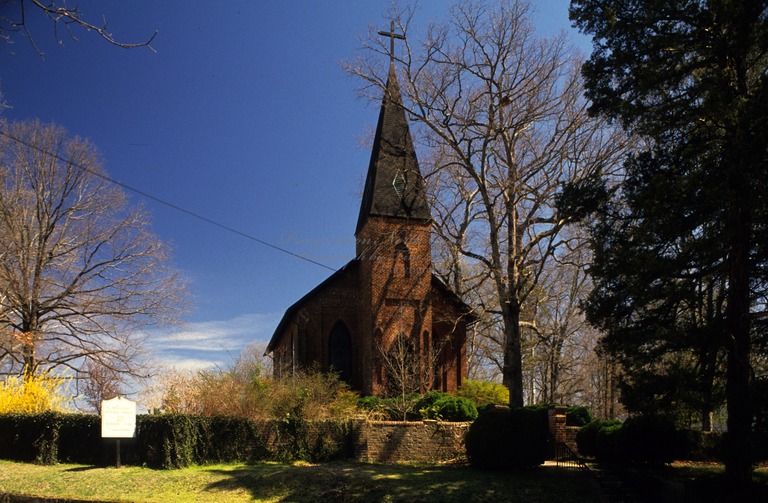
During the 1820s, Hancock and Berry built the Hillsborough Academy (ca. 1822), and more than likely Eagle Lodge, the local Masonic hall, and St. Matthew’s Episcopal Church. At Eagle Lodge, an elegant, rectilinear Flemish bond brick building with a small, Ionic portico, Hancock and Berry were working from plans by architect William Nichols, which had been on display locally. Nichols was also involved in planning St. Matthew’s, a small rectangular building of Flemish bond brick with modest Gothic Revival details. It is not known whether Berry and Nichols actually met, but if they did, Berry probably learned much from the English architect. Over the years, as recorded in receipts and bills in family papers, Berry built or remodeled many Hillsborough houses and other buildings in brick or frame, and he also accomplished smaller masonry jobs such as chimneys, outbuildings, and the like along with larger projects.
Beginning in the 1820s, too, Berry and his associates also undertook projects beyond Hillsborough. For the Person County Courthouse (1825), Hancock, Berry, and carpenter John A. Faucett gave the winning bid for $2,029 in 1824, and evidently helped the commissioners in drawing the final plan and writing up the specifications; the plan has been lost, but detailed specifications survive in county records. Several miles west, for St. Luke’s Episcopal Church (ca. 1827-1828) in Salisbury, Berry constructed a small church of Flemish bond brick with Gothic Revival lancet windows, similar to St. Matthew’s in Hillsborough.
Throughout his career, Berry’s training and skills as a bricklayer informed his work. He typically employed Flemish bond brickwork with its subtle checkerboard of headers and stretchers, a traditional bond indicative of the bricklayer’s best work, and he continued this practice into the 1850s even when other bonds had become popular, including 1:5 common bond and running bond (without visible headers).
Through careful study, Berry also developed his skills in design. He often drew upon the architectural books of Owen Biddle (especially for stair treatments) and Asher Benjamin. A copy of Owen Biddle’s Young Carpenter’s Assistant (1805; 1815 edition) inscribed with the names of John Berry and John Faucett is held by the University of North Carolina Library in Chapel Hill. Berry explained his approach in a letter to Thomas Ruffin on June 16, 1831, when he asked Ruffin to recommend him to the Caswell County building commissioners for the proposed Caswell County Courthouse in Yanceyville: “I have procured a number of books on the science of Buildings and have made it my study for a number of years back, and I flatter myself at this time from the experience I have had both in practice and theory that I can have their building executed in good stile and as substantially as any person in this section of the country.”
Berry gained the Caswell County contract, which at $5,000 was his largest to date, for a 40 by 55 foot, 2-story brick building with hip roof and both “Doreck” and “Gothick” elements. It was completed in 1833. Berry family tradition states that the county commissioners were so pleased with their new building that they employed an artist to paint two portraits of Berry, one for the courthouse, and one as a gift to Berry; only the latter survives. Although no other works by Berry are documented in Caswell County, it is possible that he was involved in other local Greek Revival brick buildings, such as Clarendon Hall, built ca. 1842 for Thomas Johnston, a leading citizen, and featuring Flemish bond brickwork and details from Owen Biddle’s Young Carpenter’s Assistant and Asher Benjamin’s Practical House Carpenter.
Increasingly important projects soon followed, including major buildings for colleges and universities. In 1835 Berry began construction of the Wake Forest College Main Building (165 feet by 65 feet) for the recently established Baptist college. Berry had proposed a design, which had been accepted, but then the trustees switched to a design by a Mr. Ligon. Berry took the contract for construction at $13,000. It was a symmetrical building of simplified Palladian design—similar to South Building at the University of North Carolina (see Samuel Hopkins). Berry was subsequently cited as the architect as well as the builder. Berry also built a pair of Greek Revival faculty houses adjoining the campus, of which South Brick House survives.
As Berry’s practice expanded, his workshop operation typified the leading builders of his day. On some projects, he took a contract jointly with other artisans including carpenter John A. Faucett. Sometimes he contracted separately for the masonry work, while a carpenter took the carpentry contract. Often, however, Berry took on contracts for entire buildings. Although his specialty was brick construction, as he expanded his shop, he increased its capacity to accomplish entire projects including all trades. By 1850 he owned 44 slaves, doubtless many of them employed in his building business. These workmen included such skilled slaves as carpenter Joseph Nichols and tinner Ned Haughawout.
Berry’s large shop also enabled him to assign workmen as needed to accomplish several projects at a time. One client, Lucy Battle of Chapel Hill, reported in 1851 that, on one day, “Capt. Berry’s six workmen” were on the job, and, on another day, there were “two white & two colored ones engaged . . . the Capt. Stays with them a good part of the time.” For distant jobs, according to his granddaughter Margaret Berry Street, “the family tradition is. . . . that when Captain Berry started to erect a building, he moved his family, his tools and equipment, and of course, his men to the site and provided quarters for all to live there until the building was completed.” He typically cut the timber and made the brick as close to the building site as possible. “After the building was finished, the Captain took his family, his tools, equipment, wagons and teams, and either went back home or to another job where the same procedure was repeated.”
The high point of Berry’s career and his best known work was the premier edifice in his home community, the Orange County Courthouse he built in Hillsborough in 1844-1848. One hundred years later, the scholar Talbot Hamlin wrote in Greek Revival Architecture in America that it was “one of the best of its type anywhere in the country. Its four-columned, widely spaced Greek Doric portico, its unusually forceful and well-designed cupola, and its quiet brick walls are almost perfect of their kind.” Berry drew upon his knowledge of classicism from his architectural books to design as well as build the courthouse. The project was so important to him that he ran a notice in the local Hillsborough Recorder on June 20, 1844, that he would not run again for the state legislature because “This work, to be well executed (as I intend it shall be) will require my constant attention.” The temple-form courthouse is constructed of brick in beautifully laid Flemish bond. The Doric portico rises two stories directly from ground level, and brick pilasters carry the Doric entablature around the building. The ground floor contains offices, with the wwwcourtroom occupying the second story. Local praise ran high, with the _Hillsborough Recorder’_s editor proclaiming on March 4, 1846, that the courthouse was “not surpassed by any courthouse in the state. . . perhaps not surpassed in the Union,” and expressing special pride that it was erected by a “native son.”
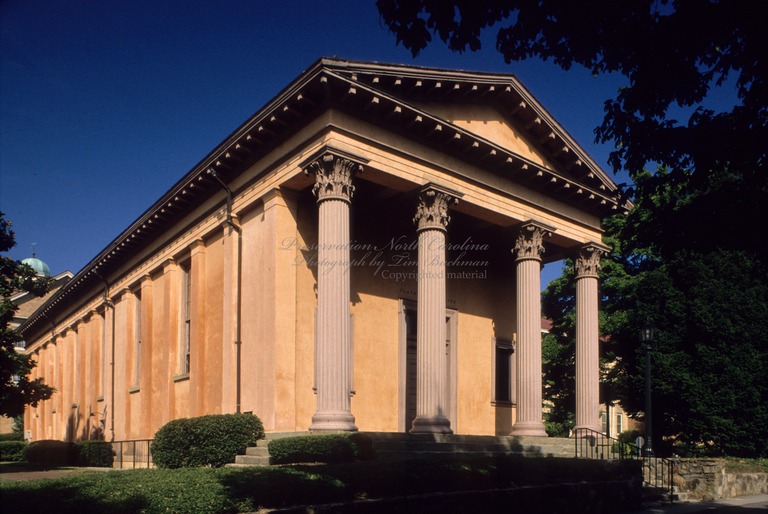
Shortly after completing the courthouse, Berry contracted for another prestigious job: construction of Smith Hall (Playmakers Theatre) at the University of North Carolina, a temple-form building designed by New York architect Alexander Jackson Davis. Berry and a partner, Henry Richards, Sr., agreed in 1851 to furnish all the materials except glass and putty and 125,000 bricks, and to finish the building “in workmanlike stile” for $6,250. Throughout the long project and several design changes, Berry communicated regularly with University of North Carolina President David L. Swain and architect Davis about nearly every aspect of the project. Revealing his own experience with pattern book classicism, he wrote to Davis on June 26, 1851, concerning the shafts of the columns, for which Davis had designed special corn and wheat capitals: “Our workmen are not famillier with the stile you give preference to but if you would send me out a plan of the collum. . . . and particular instructions, perhaps I can have them executed to our notions, but in the event we adopt the plan of fluting laid down in the books, shall we use the Doric or Ionic flute?” (quoted in John V. Allcott, “Scholarly Books and Frolicsome Blades”, 154).
In 1855, Berry and Jacob W. Holt of Warrenton contracted separately to execute the brickwork and carpentry, respectively, of a massive, Gothic Revival style edifice for St. John’s College, a Masonic institution in Oxford. The sponsoring Masons, however, lacked the funds to pay Berry on its completion, and he held a mortgage on the property until 1868, when he finally received $7,000. Berry also planned and built the Granville County Jail in Oxford. Back in Hillsborough he continued to remodel and build frame dwellings for the local gentry. A major project on the eve of the Civil War was construction of the massive Hillsborough Military Academy Main Building and accompanying Commandant’s House, both castellated designs by Columbia, South Carolina architect John A. Kay.
Berry established himself solidly in his profession, in his community, and as a property owner. In 1850, he identified himself in the United States census as an architect, and in 1860 as a builder and farmer. He owned land and numerous slaves—his $30,000 in personal estate in 1860 corresponded with the total of 45 slaves listed under his name in that year. He was listed with 44 slaves in 1850. Some of his slaves worked in his building business as artisans or laborers; others worked on his farm. He was a Mason and a member of Eagle Lodge, where he served as master. A Democrat, he served in the state legislature several terms, one of the few builders to serve in that body. Berry and his partner Samuel Hancock and his mother Rhoda were pew renters in the Presbyterian church, but he later became a member and vestryman of the Episcopal church, and still later moved to the Baptist church, presumably, since he served on the board of trustees of Wake Forest College. In his profession, his reputation was such that he was frequently called upon to arbitrate on disputes over building projects, including one case in Raleigh, one in Goldsboro, and another one in Chapel Hill. At Chapel Hill, he was asked to evaluate Dabney Cosby’s workmanship on university buildings—and found the work inadequate. “Come up and examine the courthouse,” he wrote to university president David L. Swain, “You would then be able to judge the difference between good and bad work.”
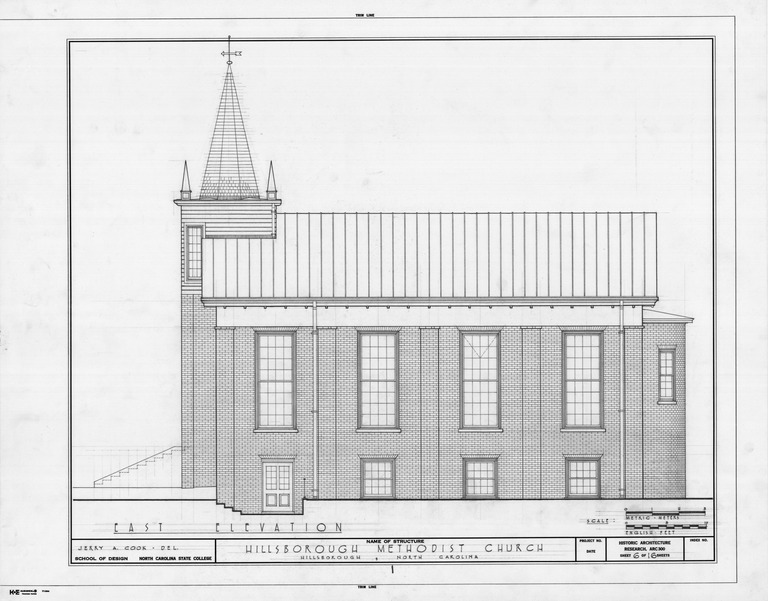
With the onset of the Civil War, construction slowed. During and immediately after the war, he served in the state legislature and in the constitutional convention of 1865. About 1860 he built the Methodist church in Hillsborough, and, later in the 1860s, he finished up another mason’s work at the Hillsborough Baptist Church. In 1869 Berry began construction of a 2-story brick building for himself in downtown Hillsborough, but before the cornerstone was laid, he caught cold, developed pneumonia, and died at his home, Sunnyside, just outside town. He was survived by his widow Elizabeth, sons Cicero and John, and daughters Amanda, Josephine, Elizabeth, Mary, and Caroline. A sixth daughter, Rosanna, had died in 1860. A granddaughter, Harriet Morehead Berry, gained statewide prominence as the “Mother of Good Roads” for her promotion of good roads in the early 20th century.
At his death, the Raleigh Sentinel of January 18, 1870, wrote of Berry, “He commenced his career with but few advantages, save those afforded by our free institutions and the condition of the society in which his lot was cast. Apprenticed in early youth to the trade of a Brick-mason, he was found at his majority a master in his art, and of a character for morality, sobriety, industry and energy, which was at once a passport to success in his business, to independence in fortune, and to the respect and confidence of his fellow citizens. Of no man could it be more truly asserted that he was the artificer of his own fortune. Improving the hours snatched from labor, he made himself acquainted with the principles of science applicable to his calling, and as an architect and draughtsman had few superiors among those in this State at least, who have been known as educated and professional architects.” The editors of the Hillsborough Recorder (January 26, 1870) praised Berry as a hard working and honest man, “A man whom our God made to ‘make a town.’”
- Alexander Jackson Davis Papers, Avery Library, Columbia University, New York City, New York.
- John V. Allcott, “Scholarly Books and Frolicsome Blades: A. J. Davis Designs a Library-Ballroom,” Journal of the Society of Architectural Historians, 33.2 (May 1974).
- John Lancaster Bailey Papers, Southern Historical Collection, Wilson Library, University of North Carolina at Chapel Hill, Chapel Hill, North Carolina.
- Battle Family Papers, Southern Historical Collection, Wilson Library, University of North Carolina at Chapel Hill, Chapel Hill, North Carolina.
- John Berry Papers, Rare Book, Manuscript, and Special Collections Library, Duke University, Durham, North Carolina.
- Catherine W. Bishir, Charlotte V. Brown, Carl R. Lounsbury, and Ernest H. Wood III, Architects and Builders in North Carolina: A History of the Practice of Building (1990).
- Catherine W. Bishir, North Carolina Architecture (1990).
- Cameron Family Papers, Southern Historical Collection, Wilson Library, University of North Carolina at Chapel Hill, Chapel Hill, North Carolina.
- Caswell County Records, North Carolina State Archives, Raleigh, North Carolina.
- Lucile Noel Dula, Pelican Guide to Hillsborough (1979).
- Mary Claire Engstrom Collection, Southern Historical Collection, Wilson Library, University of North Carolina at Chapel Hill, Chapel Hill, North Carolina.
- Mary Claire Engstrom, “John Berry,” in William S. Powell, ed., Dictionary of North Carolina Biography, 1 (1979).
- Eva Ingersoll Gatling, “John Berry of Hillsborough,” Journal of the Society of Architectural Historians, 10 (1951).
- J. G. de Roulhac Hamilton, ed., The Papers of Thomas Ruffin, 2 (1918).
- Talbot Hamlin, Greek Revival Architecture in America (1944).
- Frances Benjamin Johnston and Thomas Tileston Waterman, The Early Architecture of North Carolina (1941).
- Frank Nash Papers, Southern Historical Collection, Wilson Library, University of North Carolina at Chapel Hill, Chapel Hill, North Carolina.
- Orange County Records, North Carolina State Archives, Raleigh, North Carolina.
- George W. Paschal, History of Wake Forest College, 1 (1935).
- C. Ford Peatross, William Nichols, Architect (1979).
- Person County Records, North Carolina State Archives, Raleigh, North Carolina.
- James Webb Papers, Southern Historical Collection, Wilson Library, University of North Carolina at Chapel Hill, Chapel Hill, North Carolina.
Ann Call Cameron House
Contributors:John Berry, brickmasonDates:1828
Location:Hillsborough, Orange CountyStreet Address:SW corner of N. Wake St. and W. Union St., Hillsborough, NC
Status:No longer standing
Type:Residential
Benjamin Hedrick House
Contributors:John Berry, builderVariant Name(s):Horace Williams House
Dates:1852-1855
Location:Chapel Hill, Orange CountyStreet Address:E. Franklin St., Chapel Hill, NC
Status:Standing
Type:Residential
Images Published In:M. Ruth Little, The Town and Gown Architecture of Chapel Hill, North Carolina, 1795-1975 (2006).
Note:Records identified in 2007 in the Benjamin Hedrick Papers at the Southern Historical Collection (University of North Carolina, Chapel Hill) document that John Berry built two sections of the small house, one polygonal in plan, one rectangular, for university professor Benjamin Hedrick.
Berry Building
Contributors:John Berry, brickmason; Henry Richards, Sr., attributed brickmasonDates:1869-1870
Location:Hillsborough, Orange CountyStreet Address:105 N. Churton St., Hillsborough, NC
Status:No longer standing
Type:Commercial
Images Published In:Lucile Noel Dula, Pelican Guide to Hillsborough (1979).
Note:John Berry had begun this project but caught cold and died. It was completed after his death. Another building replaced it on the site in 1927.
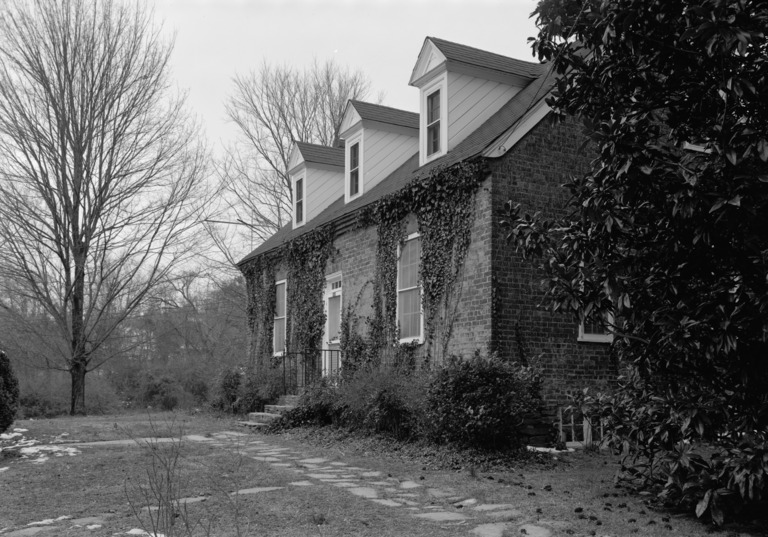
Berry House
Contributors:John Berry, attributed brickmason; Samuel Hancock, attributed brickmasonDates:Ca. 1814
Location:Hillsborough, Orange CountyStreet Address:208 W. Queen St., Hillsborough, NC
Status:Standing
Type:Residential
Images Published In:Lucile Noel Dula, Pelican Guide to Hillsborough (1979).
Note:The 1 1/2-story dwelling, one of the earliest brick buildings surviving in Hillsborough, shows less skilled brickwork than buildings done during Berry’s adulthood. Tradition says that Berry helped Hancock construct the house for Berry and his mother.
Burnside
Contributors:Dates:1834-1835
Location:Hillsborough, Orange CountyStreet Address:Opposite east end of Margaret Ln., Hillsborough, NC
Status:Standing
Type:Residential
Images Published In:Lucile Noel Dula, Pelican Guide to Hillsborough (1979).
Note:For Paul Cameron of Burnside, Berry evidently built the brick chimneys, a brick kitchen, and a large brick ice pit, which still survives. Jack Dewey of New Bern accomplished much of the carpentry.
Burwell School
Contributors:John Berry, attributed builderDates:1830s-1840s
Location:Hillsborough, Orange CountyStreet Address:319 N. Churton St., Hillsborough, NC
Status:Standing
Type:Educational
Images Published In:Lucile Noel Dula, Pelican Guide to Hillsborough (1979).
Note:At the Burwell School, John Berry built a brick music studio and a necessary house in 1837 and added a north wing to the main building in 1848-1849.
Caswell County Courthouse
Contributors:John Berry, brickmason and contractor; John A. Faucett, attributed carpenterDates:1831-1833
Location:Yanceyville, Caswell CountyStreet Address:Yanceyville, NC
Status:No longer standing
Type:Public
Note:Detailed specifications for the brick Caswell County Courthouse of 1831-1833 survive in Caswell County Records, North Carolina State Archives, Raleigh. These state that John Berry’s Caswell County Courthouse was to be two stories tall and measure 50 by 55 feet, with the courtroom and jury rooms on the ground floor and a gallery and offices on the second floor. The gallery was to be in the “Doreck” order, but enclosed with “Gothic panel work” It would have a cove ceiling, ornate stucco ornament, and exterior doors with “double elliptical arches sprung over them.” Berry’s courthouse was the predecessor of the Caswell County Courthouse (1858-1860) by architect William Percival.
Commandant's House
Contributors:Dates:1859-1861
Location:Hillsborough, Orange CountyStreet Address:Hillsborough Military Academy, Barracks Rd., Hillsborough, NC
Status:Standing
Type:Educational
Images Published In:Lucile Noel Dula, Pelican Guide to Hillsborough (1979).
Mills B. Lane, Architecture of the Old South: North Carolina (1985).
Eagle Lodge
Contributors:John Berry, attributed builder; John A. Faucett, probable carpenter; Martin Hanks, carpenter; William Nichols, architectDates:1823
Location:Hillsborough, Orange CountyStreet Address:142 W. King St., Hillsborough, NC
Status:Standing
Type:Fraternal
Images Published In:Catherine W. Bishir, North Carolina Architecture (1990).
Catherine W. Bishir and Michael T. Southern, A Guide to the Historic Architecture of Piedmont North Carolina (2003).
Frances Benjamin Johnston and Thomas Tileston Waterman, The Early Architecture of North Carolina (1941).
C. Ford Peatross, William Nichols, Architect (1979).Note:Local tradition claims William Nichols as the architect and the young John Berry and his older associate Samuel Hancock as the brickmasons for the Eagle Lodge, built in 1823 in elegantly simple classical style. Carpenter Martin Hanks recalled in his old age that while he was in Hillsborough, “I built the Masonic Hall for that town the Masons price being $4,000.”
Edmund Strudwick Kitchen
Contributors:John Berry, brickmasonDates:1837
Location:Hillsborough, Orange CountyStreet Address:114 E. Queen St., Hillsborough, NC
Status:Standing
Type:Residential
Eno Lodge
Contributors:John Berry, builderVariant Name(s):Eagles Nests Nest
Dates:1860
Location:Hillsborough, Orange CountyStreet Address:US 70-A, south bank of Eno River, Hillsborough, NC
Status:Standing
Type:Residential
First Baptist Church
Contributors:John Berry, brickmason; D. Kistler, builder; William Percival, architectDates:1860-1870
Location:Hillsborough, Orange CountyStreet Address:100 block S. Wake St. at W. King St., Hillsborough, NC
Status:Standing
Type:Religious
Images Published In:Chris Holaday, Images of America: Hillsborough (2002).
Note:The Romanesque Revival brick church was begun by D. Kistler from William Percival’s designs, but after problems, Berry completed it.
Fordyce Hubbard House
Contributors:John Berry, builderDates:1852
Location:Chapel Hill, Orange CountyStreet Address:University of North Carolina campus, Chapel Hill, NC
Status:No longer standing
Type:Residential
Frederick Nash House
Contributors:Variant Name(s):Nash and Kollock School
Dates:1819
Location:Hillsborough, Orange CountyStreet Address:Margaret Lane, Hillsborough, NC
Status:Standing
Type:Residential
Granville County Jail
Contributors:John Berry, contractor and brickmasonDates:1858
Location:Oxford, Granville CountyStreet Address:New College St., Oxford, NC
Status:Unknown
Type:Public
Hillsborough Academy
Contributors:Variant Name(s):Caldwell Institute
Dates:Ca. 1822
Location:Hillsborough, Orange CountyStreet Address:NW corner of N. Wake St. and W. Orange St., Hillsborough, NC
Status:No longer standing
Type:Educational
Hillsborough Methodist Church
Contributors:John Berry, attributed builder; Henry Richards, Sr., attributed brickmasonDates:1860-1861
Location:Hillsborough, Orange CountyStreet Address:100 block W. Tryon St., Hillsborough, NC
Status:Standing
Type:Religious
Images Published In:Lucile Noel Dula, Pelican Guide to Hillsborough (1979).
Hillsborough Military Academy Main Building
Contributors:Variant Name(s):The Barracks
Dates:1859-1860
Location:Hillsborough, Orange CountyStreet Address:Barracks Rd., Hillsborough, NC
Status:No longer standing
Type:Educational
Images Published In:Allen Alexander Lloyd and Pauline O. Lloyd, History of the Town of Hillsborough (n.d.).
Hillsborough Presbyterian Church
Contributors:John Berry, attributed brickmason; Samuel Hancock, attributed brickmasonDates:1815-1816
Location:Hillsborough, Orange CountyStreet Address:102 W. Tryon St., Hillsborough, NC
Status:Altered
Type:Religious
Images Published In:Lucile Noel Dula, Pelican Guide to Hillsborough (1979).
Note:John Berry and Samuel Hancock were pew holders at Hillsborough Presbyterian Church. A memorial plaque to Berry was placed in the church by his grandchildren in 1948.
Orange County Courthouse
Contributors:John Berry, builder; Henry Richards, Sr., attributed brickmasonDates:1844-1845
Location:Hillsborough, Orange CountyStreet Address:Courthouse Square, Hillsborough, NC
Status:Standing
Type:Public
Images Published In:Catherine W. Bishir, North Carolina Architecture (1990).
Catherine W. Bishir and Michael T. Southern, A Guide to the Historic Architecture of Piedmont North Carolina (2003).
Frances Benjamin Johnston and Thomas Tileston Waterman, The Early Architecture of North Carolina (1941).
Orange County Jail
Contributors:John Berry, builderDates:1837
Location:Hillsborough, Orange CountyStreet Address:SE Corner of Courthouse Square, Hillsborough, NC
Status:No longer standing
Type:Public
Person County Courthouse
Contributors:Dates:1825-1826
Location:Roxboro, Person CountyStreet Address:Roxboro, NC
Status:No longer standing
Type:Public
Note:Person County records (North Carolina State Archives, Raleigh) contain detailed specifications for the Person County Courthouse, defining what was expected in a well-built but not extravagant brick building, from the thickness of the brick walls (3 bricks thick at the bottom, tapering up to 2 bricks) to the paint colors (white trim, mahogany colored shutters and doors, slate colored roof, and “sky blue” ceilings). Other notable features included a hip roof, steps and sills of hewed stone, and “gambon” arches over the doors and windows. (The meaning of gambon is unclear.)
Person Hall
Contributors:Atwood and Nash, architects and engineers (1936); Thomas C. Atwood, engineer (1936); John Berry, contractor and brickmason (1843); Philemon Hodges, builder (1795-1798); Samuel Hopkins, builder (1795-1798); Arthur C. Nash, consulting architect (1936)Variant Name(s):Old Chapel
Dates:1795-1798; 1843 [renovation]; 1936 [renovation]
Location:Chapel Hill, Orange CountyStreet Address:University of North Carolina, Chapel Hill, NC
Status:Standing
Type:Educational
Images Published In:M. Ruth Little, The Town and Gown Architecture of Chapel Hill, North Carolina, 1795-1975 (2006).
William S. Powell, The First State University: A Pictorial History of the University of North Carolina (1992).Note:The building burned in 1880 and was rebuilt within the original walls and expanded. It was extensively renovated in the 1930s.
Peter Browne Ruffin House
Contributors:John Berry, builder (1840s)Dates:1840s [renovation]
Location:Hillsborough, Orange CountyStreet Address:320 W. King St., Hillsborough, NC
Status:Standing
Type:Residential
Images Published In:Lucile Noel Dula, Pelican Guide to Hillsborough (1979).
Sans Souci
Contributors:John Berry, builder (1850s)Dates:Ca. 1850s [addition]
Location:Hillsborough, Orange CountyStreet Address:E. end of E. Corbin St., Hillsborough, NC
Status:Standing
Type:Residential
Images Published In:Lucile Noel Dula, Pelican Guide to Hillsborough (1979).
Note:Sans Souci was built in the early 19th century in Federal style, and enlarged by John Berry.
Smith Hall
Contributors:Atwood and Nash, architects and engineers (1924-1925); Thomas C. Atwood, engineer (1924-1925); John Berry, builder (1849-1852); Alexander Jackson Davis, architect (1849-1852); Arthur C. Nash, architect (1924-1925); Henry Richards, Sr., attributed brickmason (1849-1852)Variant Name(s):Playmakers Theatre
Dates:1849-1852; 1924-1925 [internally reconstructed]
Location:Chapel Hill, Orange CountyStreet Address:University of North Carolina, Chapel Hill, NC
Status:Standing
Type:Educational
Images Published In:John V. Allcott, “Scholarly Books and Frolicsome Blades: A. J. Davis Designs a Library-Ballroom,” Journal of the Society of Architectural Historians, 33.2 (May 1974).
Catherine W. Bishir, North Carolina Architecture (1990).
Edward T. Davis and John L. Sanders, A Romantic Architect in Antebellum North Carolina: The Works of Alexander Jackson Davis (2000).
South Brick House
Contributors:John Berry, builderDates:1830s
Location:Wake Forest, Wake CountyStreet Address:W. South St., Wake Forest, NC
Status:Standing
Type:Residential
Images Published In:Kelly A. Lally, The Historic Architecture of Wake County, North Carolina (1994).
St. John's College
Contributors:John Berry, masonry contractor; Jacob W. Holt, carpentry contractor; Thomas J. Holt, carpenter; Henry Richards, Sr., attributed brickmasonVariant Name(s):Oxford Orphanage
Dates:1855-1857
Location:Oxford, Granville CountyStreet Address:Corner of College St. and Alexander Ave., Oxford, NC
Status:No longer standing
Type:Fraternal
Images Published In:Views: Pictorial History of the Oxford Orphanage (1922).
Note:The immense St. John’s College, a Masonic project, became the Oxford Orphanage after the Civil War, also a Masonic institution.
St. Luke's Episcopal Church
Contributors:John Berry, builder; Samuel Hancock, probable builderDates:1828
Location:Salisbury, Rowan CountyStreet Address:N. Main St., Salisbury, NC
Status:Altered
Type:Religious
Note:Local tradition credited the design of St. Luke’s to Episcopal cleric Francis Lister Hawks, as was also the case with St. Matthew’s in Hillsborough.
St. Matthew's Episcopal Church
Contributors:Dates:1825-1826
Location:Hillsborough, Orange CountyStreet Address:St. Mary’s Rd., Hillsborough, NC
Status:Standing
Type:Religious
Images Published In:Catherine W. Bishir, North Carolina Architecture (1990).
Catherine W. Bishir and Michael T. Southern, A Guide to the Historic Architecture of Piedmont North Carolina (2003).
Frances Benjamin Johnston and Thomas Tileston Waterman, The Early Architecture of North Carolina (1941).
C. Ford Peatross, William Nichols, Architect (1979).Note:Local tradition credited the design of St. Matthew’s to cleric Francis Lister Hawks; there is evidence, however, that William Nichols took a role in the design of the modest Gothic Revival brick church.
Sunnyside
Contributors:John Berry, builder (1840s)Dates:1840s [renovation]
Location:Hillsborough, Orange CountyStreet Address:St. Mary’s Rd., Hillsborough vicinity, NC
Status:Altered
Type:Residential
Images Published In:Lucile Noel Dula, Pelican Guide to Hillsborough (1979).
Note:At Sunnyside, John Berry renovated an existing house as his own large residence in the countryside, installing such favorite elements as a Palladian window in the gable.
Twin Chimneys
Contributors:John Berry, brickmason; Samuel Hancock, attributed brickmasonDates:1810s [renovation]
Location:Hillsborough, Orange CountyStreet Address:168 W. King St., Hillsborough, NC
Status:Standing
Type:Residential
Images Published In:Lucile Noel Dula, Pelican Guide to Hillsborough (1979).
Wake Forest College Main Building
Contributors:John Berry, builder; Mr. Ligon, architectDates:1835-1836
Location:Wake Forest, Wake CountyStreet Address:Wake Forest College Campus, Wake Forest, NC
Status:No longer standing
Type:Educational
Images Published In:Kelly A. Lally, The Historic Architecture of Wake County, North Carolina (1994).
Note:Wake Forest College was founded in Wake Forest and operated there until the college was moved to Winston-Salem in the 1950s. The old college campus is now home of Southeastern Baptist Theological Seminary.
William H. Battle House
Contributors:John Berry, builder (1852); Harry, carpenter (1840s); Mr. Jenkins, carpenter (1840s)Variant Name(s):Senlac
Dates:1840s; 1852 [renovation]
Location:Chapel Hill, Orange CountyStreet Address:203 Battle Lane, Chapel Hill, NC
Status:Altered
Type:Residential
Images Published In:M. Ruth Little, The Town and Gown Architecture of Chapel Hill, North Carolina, 1795-1975 (2006).
Note:The large frame house was expanded from a smaller one in ca. 1843-1844. Whether any of the outbuildings constructed by Harry (including his own house, later inhabited by Sam Morphis) still stand, possibly on other sites, is unknown. The Battle Family Papers (Southern Historical Collection) include Lucy Battle’s reports to her husband William on the progress of Berry’s 1852 remodeling of their house, including his work and that of his team of black and white workmen. After Berry’s work, the house was remodeled again over the years.