Lane, John B. (1834-1910)
Birthplace:
New Bern, North Carolina, USA
Residences:
- New Bern, North Carolina
Trades:
- Carpenter/Joiner
- Builder
NC Work Locations:
Building Types:
Styles & Forms:
Queen Anne; Second Empire
John B. Lane (1834-1910), a leading builder in post-Civil War New Bern, was one of three sons of New Bern’s best-known antebellum builder, Hardy B. Lane, Sr. (1793-1856). The other sons were Frederick Lane (ca. 1824-1868) and Hardy B. Lane, Jr. (b. ca. 1829). Doubtless trained by their father, the Lane sons entered building practice with their father and then followed in his footsteps. John B. Lane was the most prominent, working with Frederick and Hardy Jr. as Lane Brothers for a time, and practicing his trade into the 20th century.
In 1850, the U. S. census listed Hardy B. Lane, Sr., as head of household, with his two younger sons, Hardy (aged 21) and John (aged 13) living in his household along with other family members and working in his shop. The eldest son, Frederick (aged 26), also a house joiner, headed his own household next door. As boys and young men, they probably worked with their father on some of New Bern’s most substantial and stylish antebellum buildings (see Hardy B. Lane, Sr., building list), and they continued in their trades after their father’s death in 1856.
In 1860 and 1870 Hardy B., Jr., and John B. Lane were living at home along with other family members in a household headed by their widowed mother, Harriet. Frederick, the eldest son, worked briefly after the Civil War with builder Edward M. Pavie before dying in 1868. In 1871 John B. Lane and Hardy B. Lane, Jr.—identified as the Lane Brothers—were the builders of the Weinstein Building. One of the first major downtown buildings after the war, the 3-story brick building with fire retardant features such as iron shutters was erected after an earlier building burned.
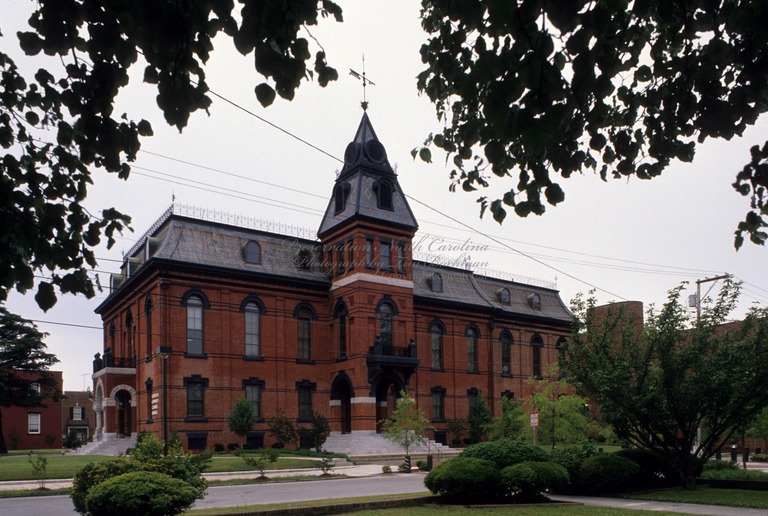
Working on his own by 1880, John B. Lane became the town’s leading carpenter-builder. His carpentry shop stood on Johnston Street. He was described in 1880 as a “master builder and architect” when he built the Craven County Jail in that year. His most important project was the Craven County Courthouse (1883), a massive and elaborately detailed brick edifice in the Second Empire style. Also built to replace a predecessor that had burned, the courthouse was designed by the firm of Sloan and Balderston—in which the principal was Samuel Sloan of Philadelphia, who also planned other major buildings in North Carolina, including the Executive Mansion in Raleigh. John B. Lane continued to build for several years, incorporating the popular Queen Anne style in such examples as the George Slover House (1894), and advertising both as “architect” and “contractor and builder” into the early 20th century.
- Catherine W. Bishir, Lynda V. Herzog, and Peter B. Sandbeck, “North Carolina Architects and Builders: Hardy B. Lane and Sons,” North Carolina Preservation, 64 (July-Aug. 1986).
- Catherine W. Bishir, North Carolina Architecture (1990).
- Catherine W. Bishir and Michael T. Southern, A Guide to the Historic Architecture of Eastern North Carolina (1996).
- Gertrude S. Carraway, Crown of Life: History of Christ Church, New Bern, N. C., 1715-1940 (1940).
- Craven County Records, North Carolina State Archives, Raleigh, North Carolina.
- Lynda Vestal Herzog, “The Early Architecture of New Bern, 1750-1850,” Ph.D. dissertation, University of California (1977).
- Peter B. Sandbeck, The Historic Architecture of New Bern and Craven County, North Carolina (1988).
Craven County Courthouse
Contributors:John B. Lane, carpenter-builder; Sloan and Balderston, architects; Samuel Sloan, architectDates:1883
Location:New Bern, Craven CountyStreet Address:300 Broad St., New Bern, NC
Status:Standing
Type:Public
Images Published In:Catherine W. Bishir, North Carolina Architecture (1990).
Catherine W. Bishir and Michael T. Southern, A Guide to the Historic Architecture of Eastern North Carolina (1996).
Peter B. Sandbeck, The Historic Architecture of New Bern and Craven County, North Carolina (1988).Note:A marble plaque dated 1883 and located on the courthouse reads, “Sloan and Balderston, Architects/ John B. Lane, Builder/ Wm. Hay, Painter.” The previous courthouse burned in 1861, and because of the Civil War and its aftermath, the county did not replace it for several years. Commissioners advertised for plans in 1880 and received completed plans in August, 1882. See Peter B. Sandbeck, The Historic Architecture of New Bern and Craven County, North Carolina (1988).
Craven County Jail
Contributors:John B. Lane, carpenter-builder; Sloan and Balderston, architects; Samuel Sloan, architectDates:1880-1881
Location:New Bern, Craven CountyStreet Address:Broad St. and Craven St., New Bern, NC
Status:No longer standing
Type:Public
Note:An 1882 report by the Craven County Commissioners stated that Sloan and Balderston supplied the working drawings and had the cells and other items for the construction of the jail made in Philadelphia. The construction was “under the immediate supervision of Mr. John B. Lane, master builder and architect of this city” (Sandbeck, New Bern).
George Slover House
Contributors:John B. Lane, carpenter-builderDates:1894
Location:New Bern, Craven CountyStreet Address:209 Johnson St., New Bern, NC
Status:Standing
Type:Residential
Images Published In:Peter B. Sandbeck, The Historic Architecture of New Bern and Craven County, North Carolina (1988).
Note:An inscription found when porch steps were replaced on the Queen Anne style residence noted “Mr. Lane” as builder, William E. Charlotte as painter, and William Willis as mason. This is one of what must have been numerous late 19th century residences built by John B. Lane.
Weinstein Building
Contributors:William H. Jones, brickmason; Frederick Lane, builder; Hardy B. Lane, Jr., builder; John B. Lane, builder; H. C. Sydney, attributed architectDates:1871
Location:New Bern, Craven CountyStreet Address:Middle St., New Bern, NC
Status:No longer standing
Type:Commercial
Note:The Weinstein building had burned in the downtown fire of 1871 and was rebuilt in a more fireproof manner. It was replaced in the 20th century.